
Toronto Is 3 Years Away From A New Housing Crisis | New Condo Sales Down 99%!
According to a bombshell new report from the Bank of Canada, we are heading toward a massive real estate and economic "supply cliff" in the GTA that will start to be felt in 2-3 years. If you’ve walked through downtown Toronto lately, you still see cranes in the sky and it looks like business as usual. But those cranes are finishing "old projects” that sold 5-6 years ago. Behind the scenes, Toronto condo presales have ground to a near-total halt.
Here’s what’s happening:
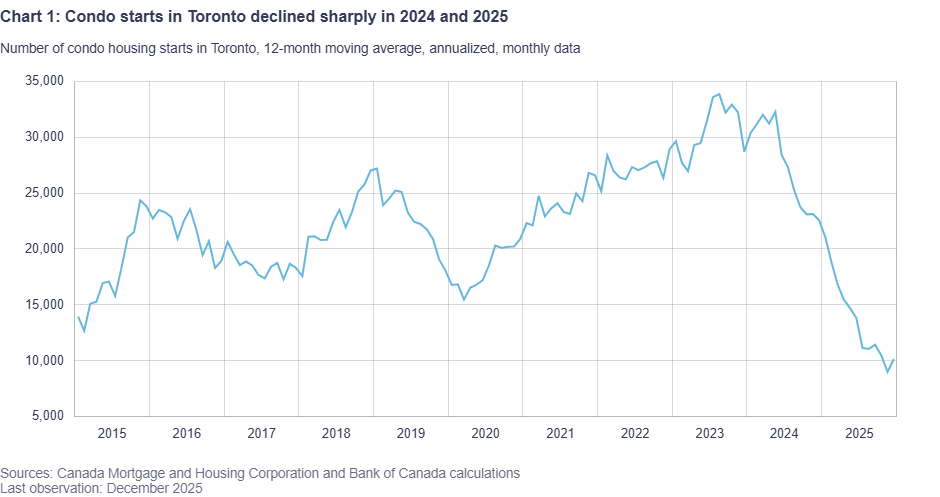
Toronto New Condo Starts Hit 35 Year Low
Condo starts in Toronto have fallen from a high of 33,919 in August of 2023 to 9,025 in November of 2025, a fall of 73%.
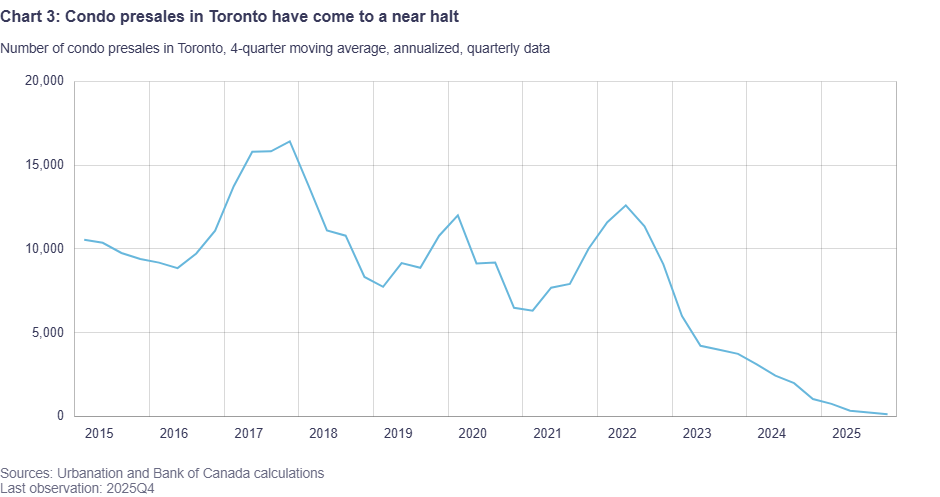
Toronto New Condo Sales Hit Lowest Record Ever (45 Years)
Condo presale purchases have fallen from a high of 16,454 in Q4 2017 to 159 in Q3 2025 (-99%).
Toronto/GTA Pre-Construction Sales Today
Prior to the 1990s, the condo market in Toronto and the GTA operated on a model where developers financed and completed buildings before offering units to the public. Buying a condo was similar to a resale purchase, as the units were move-in ready and the modern concept of pre-construction did not yet exist.
This eventually shifted to the current pre-construction model, where buyers purchase units before construction even begins. This transition moved significant risk from developers to buyers, serving as the primary funding mechanism for GTA construction over the last 30 years. In exchange for this increased risk, buyers were historically compensated with prices lower than those in the resale market.
However, this model is now broken, and we may not see it return in its current form.

1) The "Presale" Engine has Seized
To understand the current crisis, you have to understand how condos get built. Banks don’t just give developers hundreds of millions of dollars to build a tower on a whim. They usually require the developer to presell 70% of the units before a single shovel hits the ground.
Historically, investors flocked to these presales. But today, the Bank of Canada notes that presales have plummeted to the lowest numbers on record. When presales die today, the buildings that would have been completed in 3-4 years effectively disappear.

2) The Math Doesn’t Work for "The Average Investor"
For a decade, buying a condo "on paper" was a guaranteed win. You’d put 20% down, wait three years, and the unit would be worth much more by the time it was finished.
The Game has Changed:
The Price Gap: Many condos finishing today are actually worth less than what people agreed to pay for them a few years ago.
The Interest Rate Shock: Investors who thought they’d carry a mortgage at 2% are now looking at 5% or higher, making it impossible to cover costs with rent. You can make any property cash flow by putting down an extra down-payment, but this is something that most people are not able to do.
The "Micro-Unit" Problem: Developers spent years building tiny "shoebox" suites for international students and short-term renters. These units were a hit with investors because they were more affordable to buy and the cash flow worked better than buying larger units. With population growth slowing and a weaker labor market, there is now a massive oversupply of tiny units and a total lack of the larger units that actual families need.
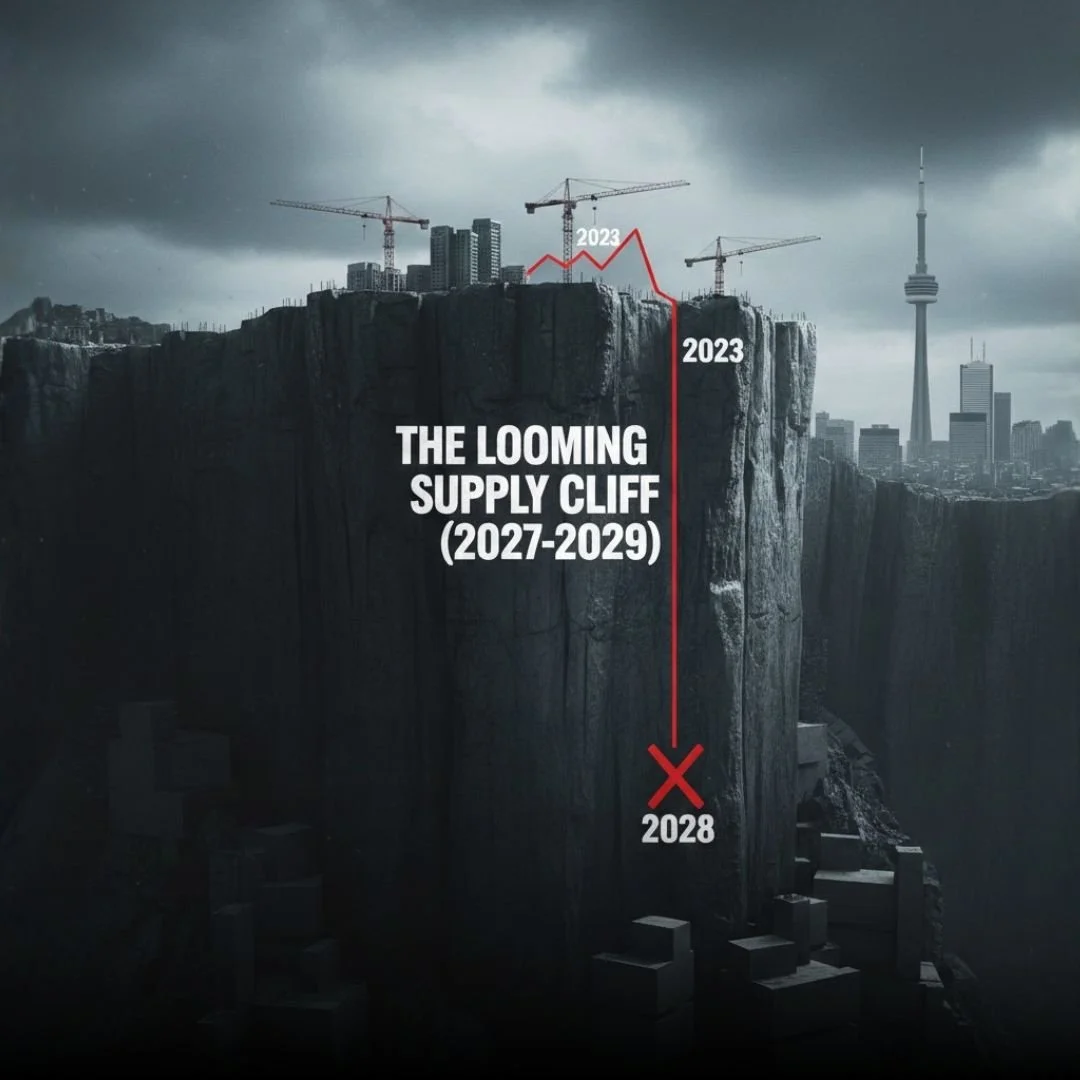
3) The Looming "Supply Cliff" (2027–2029)
Construction is a slow-motion business. The "starts" we see today are based on sales from 2021 and 2022 or earlier (I once had a condo building take 7 years to be built). Since pre-construction sales have dropped to historic lows in 2025 and 2026, there will be a period starting in about 24–36 months where completions will drop to (and stay at) near zero.
This isn't just a Toronto problem; it's a Canadian crisis. Residential construction is a massive part of our GDP. When the cranes come down and don't go back up:
Construction jobs vanish: Thousands of tradespeople and professionals will be out of work.
The Rent Spike: When no new supply hits the market in 2028, but people still need places to live, the competition for existing apartments may become cutthroat again.
Economic Stagnation: The "condo wealth effect" that powered spending in Ontario for two decades is evaporating and will have larger net effects on the economy.
Change Is Required
We are currently living through the "quiet before the storm." Pre-construction investors have disappeared, leaving sales centers and model homes empty. This lack of current investment will guarantee a housing shortage at the end of the decade that will likely be more severe than any we have seen before.
Furthermore, sales figures risk falling "below zero" if recently sold buildings fail to meet their 70% financing thresholds because these projects can be cancelled or converted into purpose-built rentals, which will further reduce the future supply of condos.
To prevent a total collapse of the housing market, the way we build in Canada must evolve.

1) Floor Plans: Build for People, Not Spreadsheets
For years, developers built "investor-grade" shoeboxes. These sub-500 square foot units were never meant to be lived in long-term; they were financial instruments.
The Change: We need a return to Livable Design. This means bedrooms that actually fit a bed and a nightstand, a location to put a TV, a balcony that fits a table and chairs, and a greater mix of larger family-oriented units in every project. If a home isn't functional for the resident, it’s not solving the housing crisis - it’s just a temporary parking spot for capital.
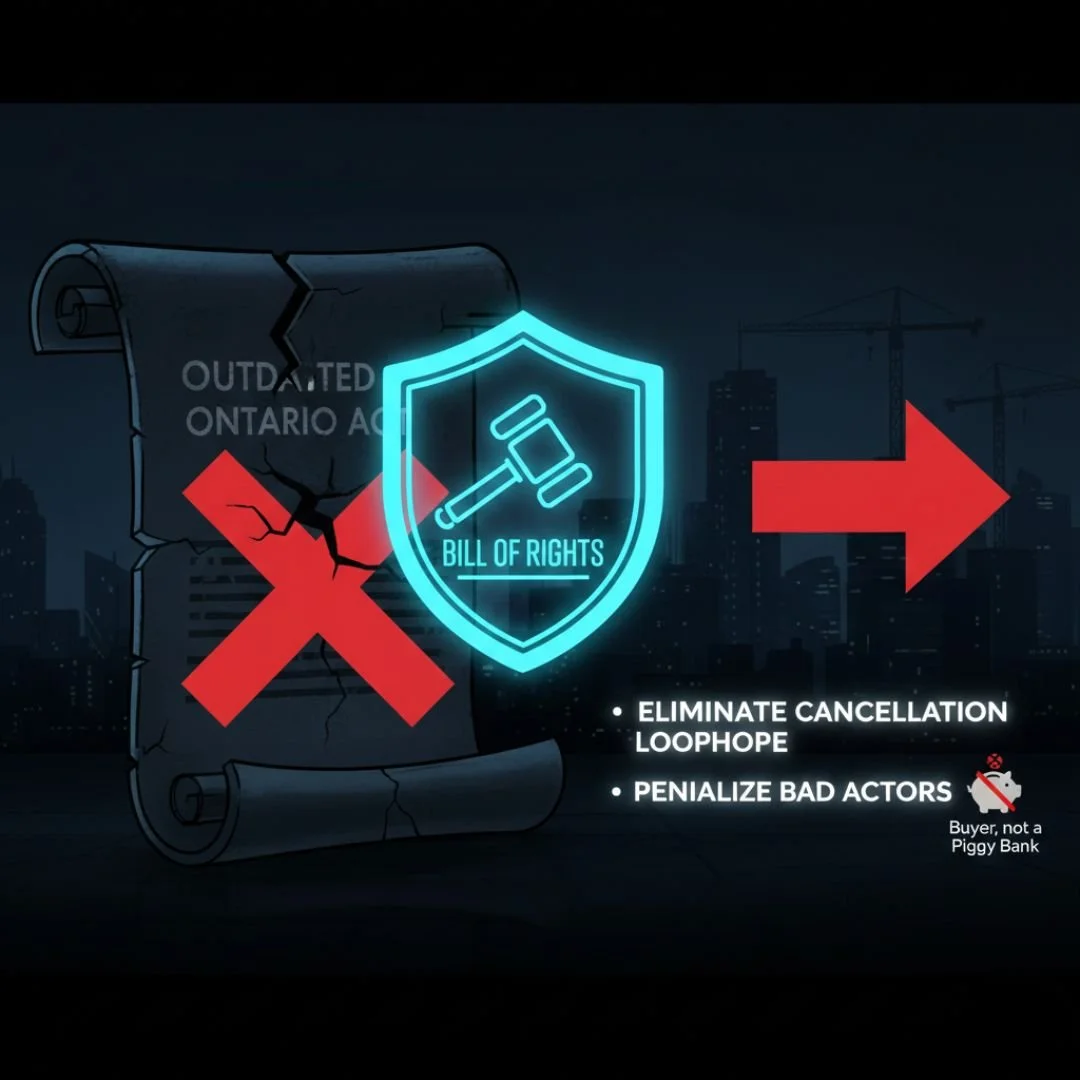
2) The Ontario Condo Act: A "Buyer’s Bill of Rights"
The power imbalance in the current Condo Act is staggering. Buyers purchase units based on the developer’s contracts, not a standardized Agreement of Purchase and Sale, like are used for the purchase of an existing property. These contracts are completely one-sided in favour of the developer, and give them broad power over the buyers who are left in the dark during construction.
The Change: The Condo Act needs to be re-written to include a standard purchase agreement to protect buyers and make sure they get what they paid for. Developers should face steep financial penalties or be barred from the market if they cancel a project only to relaunch it at a higher price. We need transparency that treats the buyer as a partner, not a piggy bank.
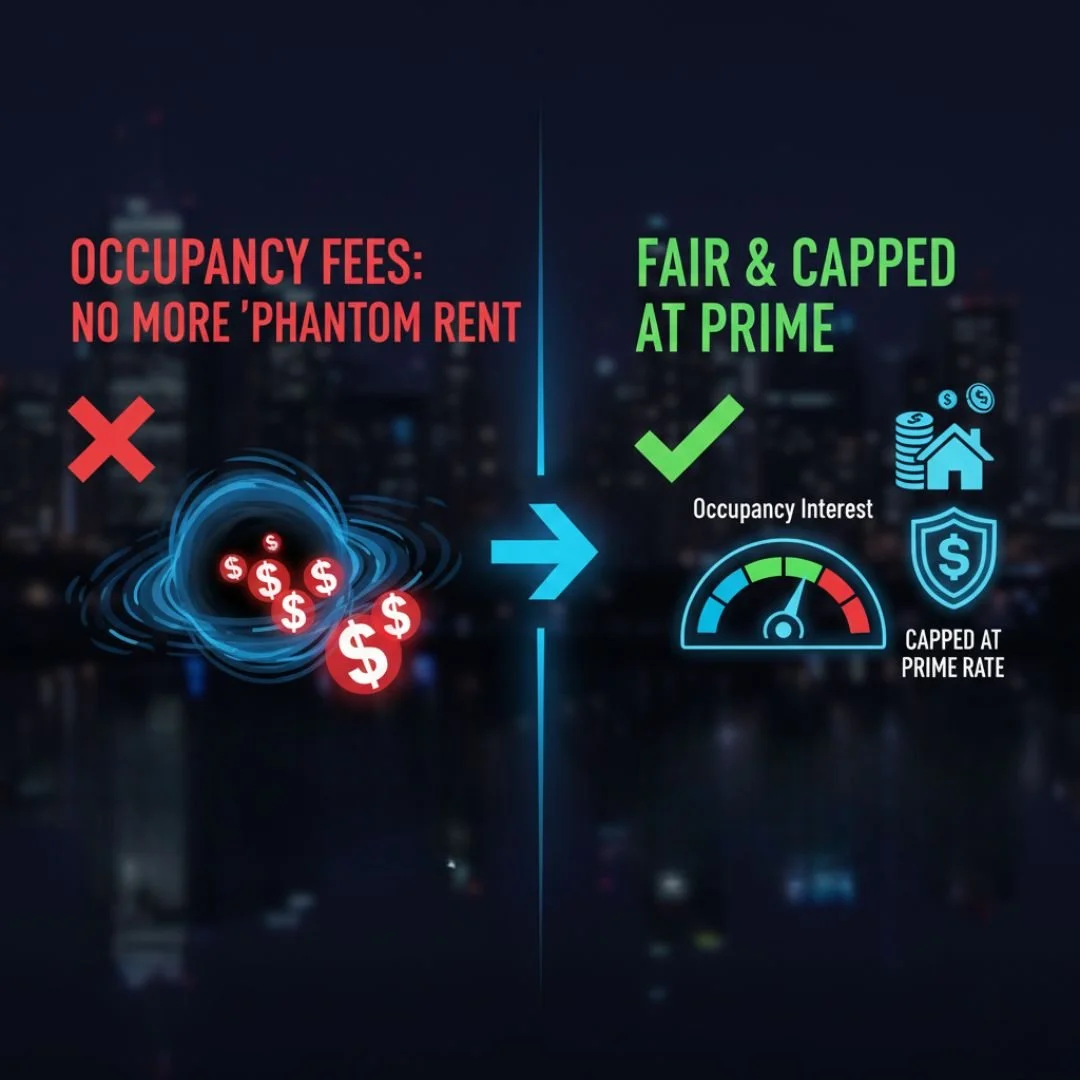
3) Occupancy Fees: No More "Phantom Rent"
Interim occupancy fees are a black hole for buyers' money. You pay the developer "rent" until the building is registered, but that money doesn't go toward your principal.
The Change: Occupancy interest must be capped at the Bank of Canada Prime Rate (not the Bank of Canada 1 Year Conventional Mortgage rate). Capping these fees creates a massive incentive for developers to close and register buildings faster - no more 12 to 24 month occupancy periods. Developers should not be allowed to profit from delays in registration and residents should not have to live in a construction zone.
Better yet - eliminate the concept of Interim Occupancy all together. This period only benefits the developer but only creates a legal limbo area for buyers where they have possession of a unit that they don’t legally own and causes all sorts of problems like the inability to sell the property or rent it out during this period (unless the developer approves). In provinces like Alberta, pre-construction properties go straight to closing (there is no occupancy) - we need to go back to this.
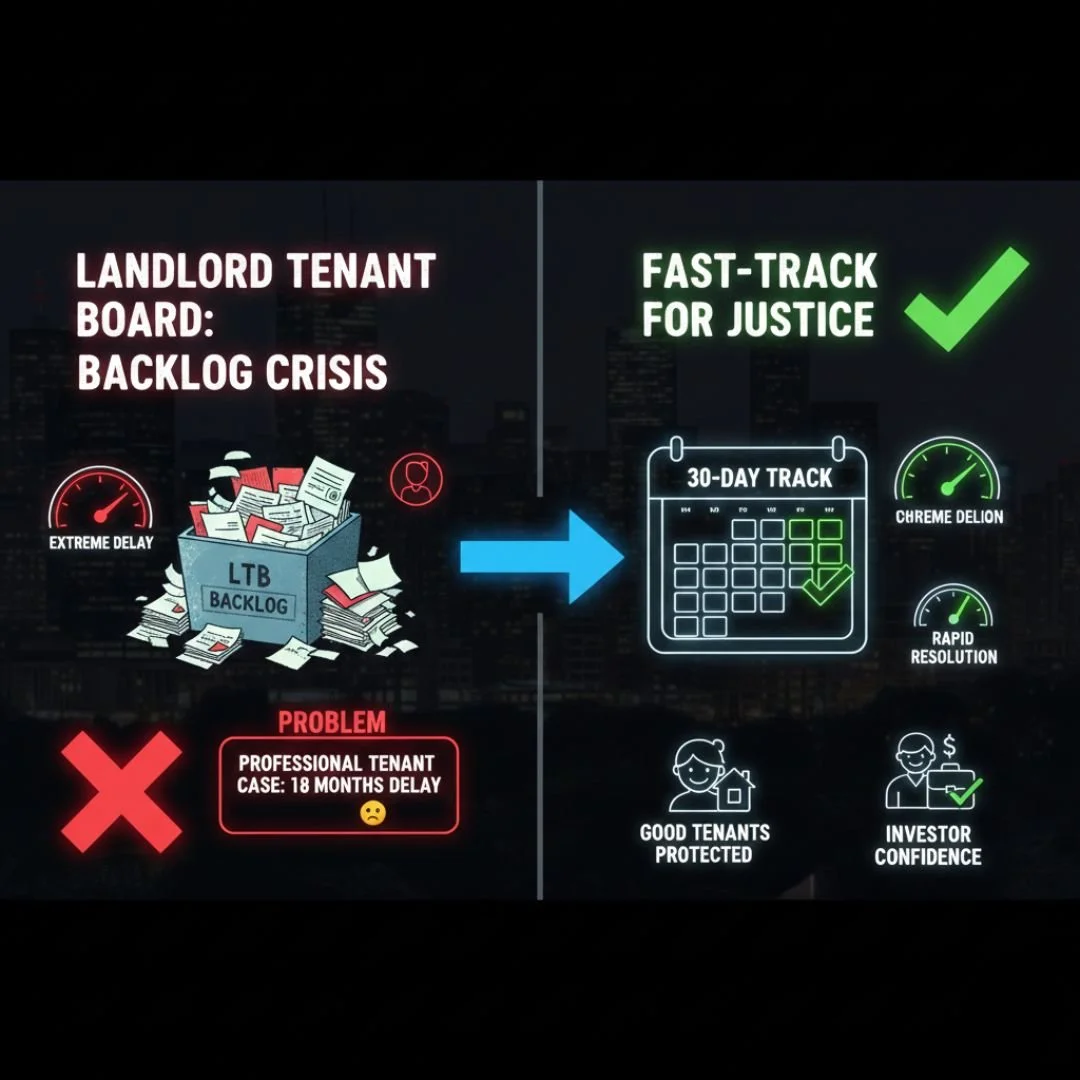
4) The Landlord Tenant Board: Fast-Track the Bad Actors
The current LTB backlog is a gift to "professional tenants" who exploit the system to live rent-free for a year or more and can lead to thousands in unpaid rent, damages, and legal bills for the landlord which can easily break their finances. This risk is a major reason why mom-and-pop investors are fleeing.
The Change: We must bifurcate the system. Simple non-payment cases should have an automated 30-day "Fast Track" for resolution and extra adjudicators hired by the province to clear the backlog. By removing bad actors quickly, we protect the 99% of good tenants and give investors the confidence to provide the rental supply Canada desperately needs.
Rent (or it’s non-payment) must be allowed to be reported to credit rating agencies - this will massively benefit good tenants as they get reward for paying their rent on time.
And get rid of rent control, it has been proven time and time again to hurt rent prices, not help affordability.
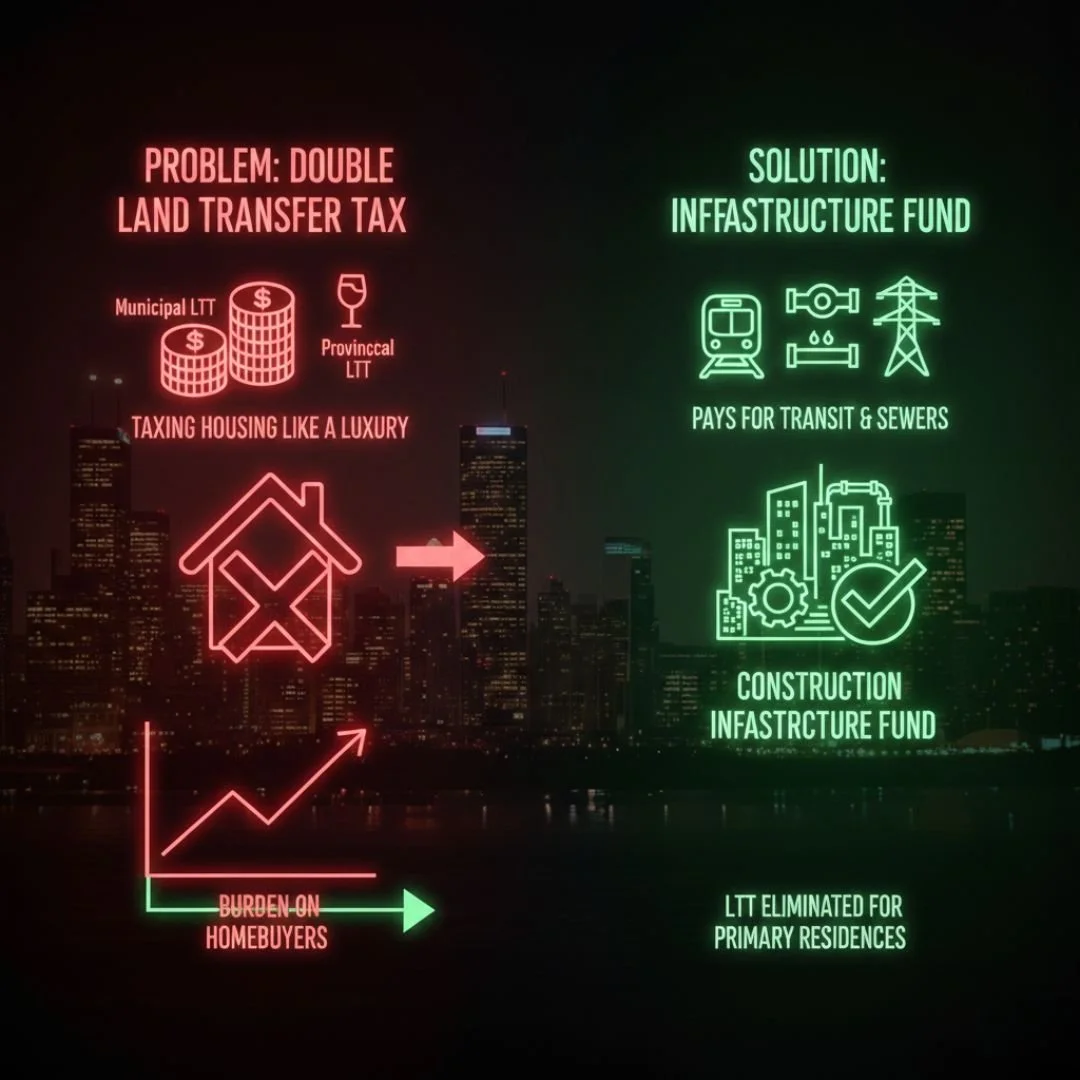
5) Taxes & Funding: Stop Taxing Housing Like a Luxury
The "Double Land Transfer Tax" and obscene development charges in Toronto treats a basic human need like a "sin tax" on tobacco or alcohol. It has been a major cash-cow for the municipal and provincial governments and it must stop.
The Change: Both the Municipal and Provincial Land Transfer Taxes need to be eliminated and development charges need to curtailed. To replace that revenue, the federal and provincial governments must move toward a Construction Infrastructure Fund that pays for the sewers and transit required for new density like has historically been done, rather than dumping those costs onto the buyers of new construction.
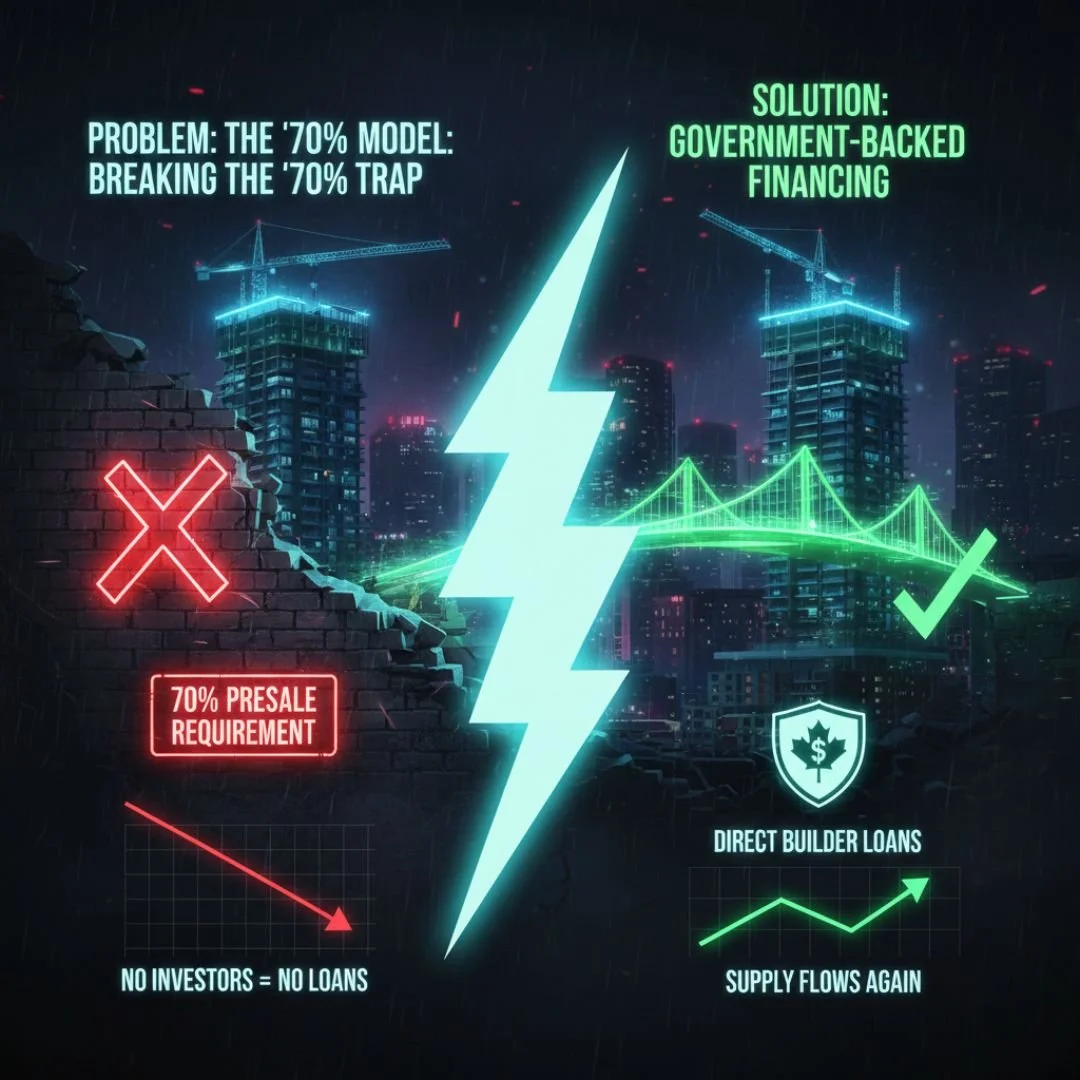
6) A New Funding Model: Breaking the "70% Trap"
The current requirement to presell 70% of a building to secure private financing is the primary obstacle blocking housing supply today. When investor activity slows, construction projects stall.
The Change: We need a shift toward government-backed construction financing. By providing low-interest, direct-to-builder loans (similar to the models used during the post-war housing boom), we can maintain construction momentum even when the private investment market is cold.
Furthermore, developers must shoulder more of the risk. If a project’s business case does not support its fundamentals, it should not be built for speculation. This shift is essential to ensure that housing remains a basic need rather than a financial commodity.

7) The Missing Piece: Ending "Death by a Thousand Permits"
We can change the taxes and the floor plans, but if it still takes 7 to 10 years to get a development approved in Toronto, the supply cliff is inevitable.
The Change: We need Automatic Approval for Density and fast-tracking project proposals. If a project meets a pre-defined set of livability and zoning standards, it should be "As-of-Right." We cannot afford to let local NIMBYism and municipal red tape hold the national economy hostage any longer.
Where the Opportunity Is Today
Investors haven't disappeared; they are simply waiting for the right opportunity. We are currently at a crossroads where Bank of Canada data serves as a roadmap for savvy investors. The "70% presale trap" has disrupted the traditional development model, and with construction starts at 30-year lows, the 2027-29 supply cliff is now a mathematical certainty.
Simultaneously, the return to four- and five-day in-office mandates is reintroducing the "commute penalty." As professionals find long suburban commutes unsustainable, we are seeing a "flight to convenience" that is driving urgent demand back to the downtown core. In this environment, a condo is a strategic career asset for those prioritizing their time and mental health.
When construction slows further in two years and the market realizes there is no new inventory, I expect price stabilization and a potential upward correction that will catch the "wait and see" crowd off-guard.
While headlines scream "crisis," the Condo Millionaire mindset sees a "clearance sale." For the first time in a decade, the power has shifted entirely to the buyer. If you know where to look, there are incredible opportunities hiding in plain sight:

Opportunities In Today’s Market
Distressed Assignments: Many investors who purchased at the peak in 2021 and 2022 are now facing unplanned negative cash flow. As a result, we are seeing assignment sales where sellers are willing to forfeit their entire deposits or even pay buyers to offload contracts, sometimes at prices below current resale value.
The "Livable" Resale Gap: While smaller "investor shoeboxes" are sitting on the market, larger, more functional properties—especially those with parking or unique features like large terraces—are seeing high demand and holding their value. Resale properties continue to sell at a significant discount compared to pre-construction, and we are finally seeing "unicorn" opportunities that offer positive cash-flow fundamentals again.
Negotiation Leverage: We are currently in a true buyer’s market. Beyond price, buyers now have the leverage to include home inspections, financing conditions, and aggressive price discounts that were impossible to negotiate just a few years ago
The Bottom Line: A Choice Between Evolution and Collapse
We are currently standing at a crossroads. For years, Toronto’s housing market has functioned on "autopilot," fueled by low interest rates and a relentless influx of capital. But the autopilot has disengaged. With new sales down 99% and the "70% presale" model effectively dead, the city is heading toward a multi-year supply vacuum that will start to be felt in 2028 and 2029.
If we continue to treat housing as a luxury to be taxed rather than an infrastructure to be built, the consequences will be generational. The most dangerous trend of the last 10 years wasn’t just high prices; it’s the formalization of a "two-tier" society where homeownership is no longer a milestone of merit, but a byproduct of inheritance with the market increasingly gated by the "Bank of Mom and Dad." In 2024, nearly 31% of first-time buyers required family gifts (averaging over $115,000), just to qualify - we need more affordable options.
If this isn't addressed, Toronto risks becoming a "feudal" economy. When the only people who can buy are those who already own, we lose the social mobility that makes a city vibrant. We face a future where the "working class" is permanently relegated to a rental market with zero equity, while a narrow cohort of the "asset-owning class" captures 100% of the city’s future growth. This isn't just a housing issue; it’s an economic dead end that will eventually drive our brightest talent to leave the country entirely.
Final Thoughts: Don’t Wait to Buy Real Estate, Buy Real Estate and Wait
I know this is cliché, but if you are considering buying a property, you cannot time the market. The market correction in Toronto has already happened with prices down 30-40% in some cases. The "quiet before the supply storm" is your window of opportunity to find an incredible property for yourself - without bidding wars or scare tactics because the power is now in your hands (for the time being).
While many wait for interest rates to hit rock bottom or for the government to "fix" the market, competition and bidding wars will eventually return for good product as the supply cliff arrives. The millionaires of the next decade are being made right now in the silence of sales centers, and at the negotiating table with sellers, securing the units that simply won’t exist by 2028.
Are you going to be a spectator, or will you be an owner when the supply runs dry?
Kyle Dovigi
Real Estate Broker | CondoMillionaire.com
Anyone can become a Condo Millionaire - it all starts with one.
Real Talk. Honest Advice.
Want to work with a professional who will give you honest advice?