
Calgary Real Estate Market Update: June 2026
You've probably seen the headline by now that condo prices down almost 9% year-over-year, and if you bought in the last 5 years, you've felt that number personally, not abstractly - your unit is worth less than when you bought it, your rent roll is probably softer than your pro forma said it would be, and every month, CREB publishes another press release confirming it.
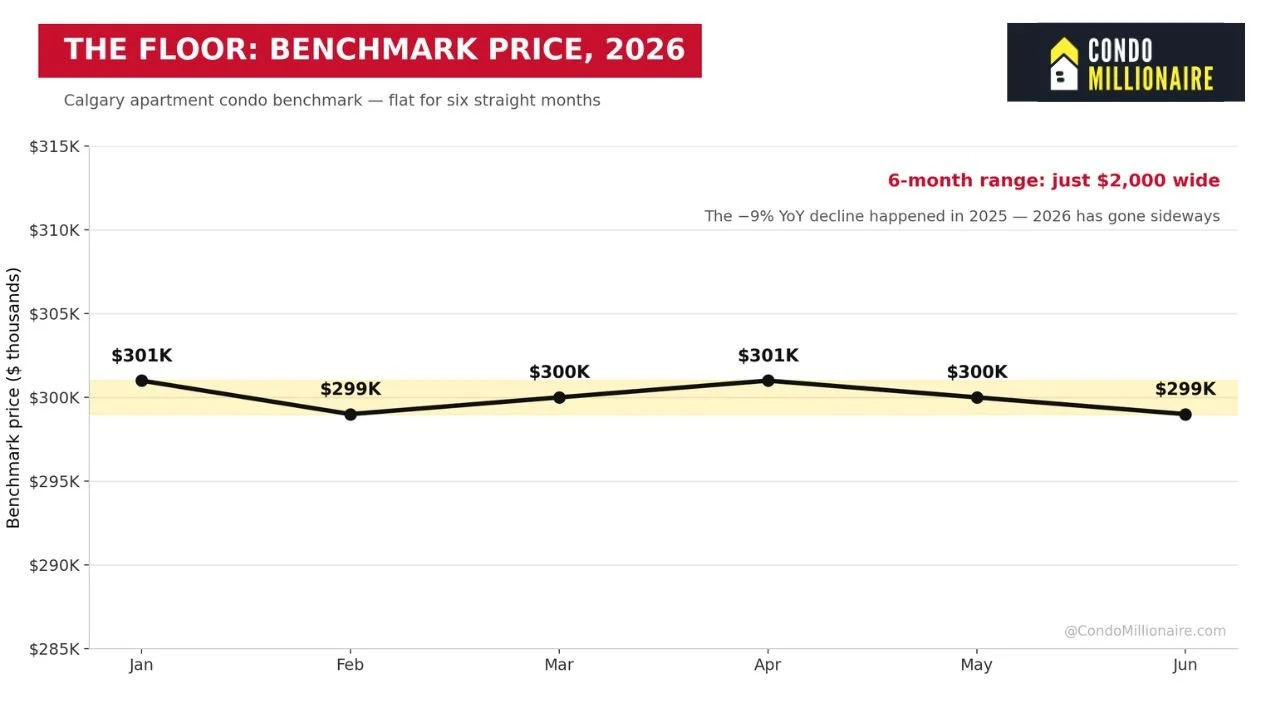
Because here's what the -9% headline doesn't tell you; that decline has already happened - it happened through 2025. What the June numbers actually show is a benchmark price that has now sat between $299,000 and $301,000 for six consecutive months. Flat.
The question for an investor then is no longer "how far will this fall?" because the data suggests we're finding out where the floor is. The question now is "how long do we grind sideways, and what should I be doing while we do?"
So let's skip the spin and do what actually helps: figure out where you are in this cycle, and what the data says about what comes next.
Don’t forget that I own condos in this market too.
It's Not Even Across the City
This district-by-district spread matters a lot if you're deciding where to buy right now, or if you're trying to figure out how your existing unit stacks up against the citywide average. A blanket "condos are down 9%" headline can hide a much rougher reality in some pockets - and a relative bright spot in others.
If you own a condo in the Northeast or East, brace yourself because those districts are seeing price declines exceeding 14% YOY, the steepest in the city. The Northwest district is faring comparatively better, with the smallest decline in the segment at roughly 7.5%. Still a decline, but a meaningfully softer one.
Why This Is Happening: It's a Supply Story, Not Just a Demand Story
It's tempting to blame this entirely on softer demand, but the CREB data points to something more structural.
Years of record-high housing starts are now completing and hitting the resale and rental market simultaneously. Inventory growth has been concentrated almost entirely in high-density product (condos and, to a lesser extent, townhomes), while detached supply has stayed comparatively tight. That's exactly why detached prices are holding up (and even hitting record highs in the City Centre and West districts) while condo prices are getting squeezed from both a completions wave, and slower absorption.
In other words: this isn't a story about Calgary real estate broadly weakening. It's a story about one segment absorbing a supply glut that took years to build and will take time to clear.
The Rental Market Is Telling the Same Story
If you're a condo investor, the resale numbers are only half the picture, and the rental numbers confirm the trend. Calgary's rental vacancy rate has moved from an extraordinarily tight 1.4% in 2023 to 4.6% in 2024 (the largest single-year jump of any major Canadian city), and CMHC now projects it to reach roughly 5.7% in 2026 and peak around 6.2% in 2027 before stabilizing.
The pressure isn't evenly distributed, either. CMHC's mid-year rental update notes that vacancies are highest in buildings completed after 2020 which is exactly the product type most investor-owned condos compete against, and that new units are taking meaningfully longer to lease, sometimes months. Investor-owned rental condos are directly competing with a wave of purpose-built rental completions, and asking rents for condos are down roughly 4–8% YoY. Meanwhile, townhouse and single-family rentals remain comparatively tight, because almost all of the new construction has been concentrated in the condo segment.
For a condo landlord, that means the same supply wave hitting your resale value is also compressing your rent roll at the same time.
The Pipeline: More Supply Coming, But the Tap Is Slowing
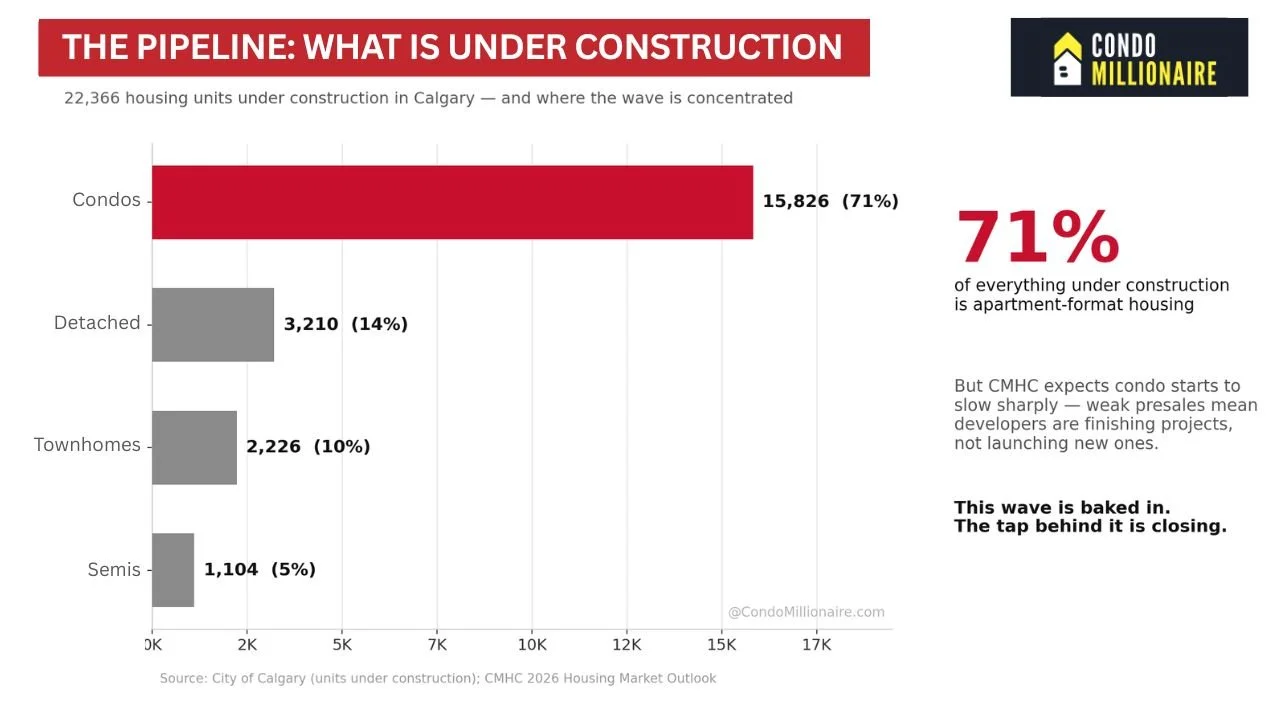
Here's the part that matters for anyone trying to time this market. According to City of Calgary data, there are over 22,000 housing units currently under construction (and condos account for roughly 71% of them, 15,800 units). That's the supply still working its way toward completion, and it's why this overhang won't clear in a quarter or two.
But there's an opposing force forming. CMHC's 2026 outlook projects that condo construction will slow more noticeably than other housing types, with developers increasingly focused on finishing existing projects rather than launching new ones. Weak presale activity makes new condo projects hard to finance, which chokes off future starts. Translation: the supply wave currently hitting the market is largely already baked in and the pipeline behind it is thinning. Markets like this tend to overshoot on the way down and then tighten faster than expected once completions dry up.
To prove this point, none of the major Calgary developers I work with have launched a new condo project since 2024.
Demand Is the Other Half: Population Growth Is Cooling
The demand picture explains why the supply is landing so hard. Calgary's population is estimated to grow by about 34,000 people in 2026 which is still healthy, but a significant deceleration from roughly 53,000 the year before and a staggering 88,000 in 2023/24. That earlier surge is precisely what triggered the record construction boom that is now completing; the slowdown is why those completions are meeting less absorption than developers planned for.
This is Lurie's point about cooling migration in a nutshell: the units were built for a growth rate that has since moderated. Demand hasn't disappeared because Calgary is still adding tens of thousands of residents a year and remains one of the strongest economies among major Canadian cities; it’s just no longer growing fast enough to instantly absorb record supply.
What This Means If You Own a Condo in Calgary
I know this isn't the fun part of the update, but here's the reality: if you're a condo owner sitting on the sidelines hoping prices bounce back quickly, the data doesn't support that in the near term. Five months of supply and a 45% sales-to-new-listings ratio mean buyers currently have the leverage.
A few things worth thinking through:
If you're planning to sell in the next 6–12 months, units can still sell quickly but you must price them competitively and realistically according to the current market conditions.. Overpricing into a market with this much inventory typically just means sitting on the market, and a larger eventual price cut later.
If you're not in a rush, simply hold on and let the market work through this inventory overhang. Inventory will eventually be absorbed, especially as immigration levels start to open back up in 2027.
The National Picture
It's worth zooming out to the national picture and putting everything into perspective because even after years of appreciation, Calgary's condo benchmark near $299,000 remains a fraction of comparable entry points in Toronto or Vancouver. Calgary continues to offer among the best rent-to-income fundamentals of any major Canadian city thanks to its high household incomes. And unlike Toronto, where the pre-construction condo market has literally reached zero - Calgary's correction is happening against a backdrop of continued (albeit slower) population growth and one of the strongest projected GDP growth rates among major Canadian cities in 2026. The long-term demand thesis isn't broken; the short-term supply picture is just crowded.
If you're trying to figure out what this means for your specific building, district, or investment strategy, that's exactly the kind of conversation worth having before you list, buy, or hold. Get in touch and I would be happy to review your portfolio so we can strategize on your best path forward.
Considering An Investment?
The opportunity in in Calgary today is found in the units that buyer’s have failed to close on, and the developer is now liquidating below resale market values. I have 2 bedroom units from the mid-$200s that cash flow and are irresistible with a long-term outlook!
DETAIL BY PROPERTY TYPE
(Statistics from the Calgary Real Estate Board)
Condos
Sales: 403 (-30.4% from May 2025)
New Listings: 961 (-21.9%)
Inventory: 2,070 (-0.8%)
Months of Supply: 5.1 (seller’s market)
Days on Market: 46 (up from 41 days)
Benchmark Price: $300,400 (-10.4%)
Townhomes/Row Houses
Sales: 350 (-23.6% from May 2025)
New Listings: 695 (-9.0%)
Inventory: 1,173 (+5.1%)
Months of Supply: 3.4 (balanced market)
Days on Market: 38 (up from 33 days)
Benchmark Price: $422,300 (-6.9%)
Detached Houses
Sales: 1,192 (-6.5% from May 2025)
New Listings: 2,195 (-9.3%)
Inventory: 2,916 (-2.6%)
Months of Supply: 2.4 (seller’s market)
Days on Market: 28 (unchanged from 28 days)
Benchmark Price: $747,800 (-2.8% but +3.3% YTD!)
Book A Call to Review Investment Options
I’m here to help you analyze the market and make decisions that fit your investment goals, get in touch today!
Calgary offers some of the most affordable investment opportunities in Canada with some of the highest rents per dollar invested!
(and properties that actually cash flow!)